
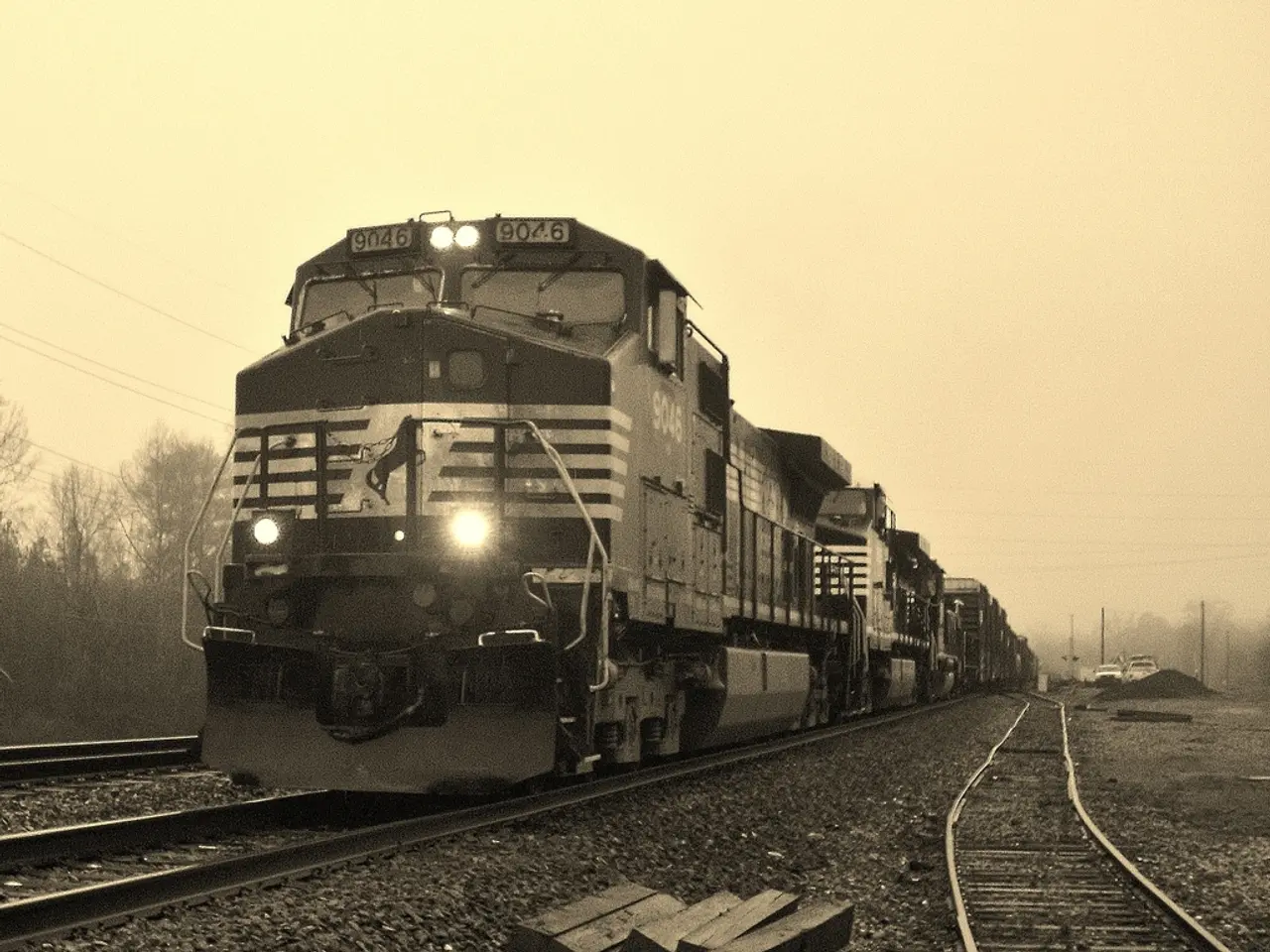
Railway delays persist throughout the summer months.
The German rail network is currently undergoing a significant transformation, with modernisation projects spanning several decades and billions of euros. However, the journey is fraught with challenges, as cancellations and detours on various routes, including Stuttgart-Munich, Berlin-Rostock, and the IC connection Stuttgart-Zurich, have recently been reported.
Deutsche Bahn (DB), the national rail operator, is facing a chronic crisis, with low punctuality being a major concern. Only about 63.4% of long-distance trains currently arrive within 15 minutes of schedule, putting pressure on DB to renovate and expand infrastructure more efficiently to improve service reliability.
Future plans include expansive projects like the Munich S-Bahn expansion and the Rhine railway modernisation, led by construction firms such as HOCHTIEF. These projects aim to alleviate congestion, upgrade tracks, and construct new tunnels and stations to support increased capacity and regional connectivity.
However, financing and operational challenges persist. DB has pushed to delay some modernisation efforts citing costs and congestion issues, which raises concerns about meeting climate and transit efficiency goals. While the federal government is providing record funding, the scale and complexity of renovation—including upgrading interlocking units and side sections—make timely progress difficult. These financial and logistical hurdles contribute to ongoing punctuality problems despite increased investment.
Key challenges and issues include lengthy project timelines, financial strain and cost management, service reliability and punctuality problems, the complexity of projects, political and regulatory oversight, and a lack of transparency regarding trains that have broken down due to technical problems.
Despite these challenges, Germany's rail modernisation is a ambitious endeavour with significant ongoing investment and ambitious future plans. The federal government should enforce an adjustment of the DB AG group and not rely on increasing financial resources to solve the crisis in the long run. The railway company is currently engaged in the "Major Overhaul" project, which involves the renewal of 41 main lines with a length of 4,200 kilometers. The German Railway is also working towards offering a nationwide disruption map to its customers.
Construction sites are prevalent across the German rail network, with the highest number of sites reported in Berlin, followed by Essen and Munich. In 2026, lines such as Hagen-Wuppertal-Cologne, Nuremberg-Regensburg, Obertraubling-Passau, and Troisdorf-Wiesbaden will be renovated. The following year, corridors like Rosenheim-Salzburg, Lehrte-Berlin, Bremerhaven-Bremen, and Fulda-Hanau will be bundled and renovated.
The rail network resembles a patchwork quilt due to impairments and disruptions, with replacement traffic in place instead of ICE and IC between Berlin and Frankfurt/Oder, and reduced train traffic between NRW and Hannover or Berlin. The modernisation of more than 40 heavily travelled and urgently in need of renovation lines will take at least five years longer than originally planned.
Despite these setbacks, the railway company admits that the infrastructure is prone to disruptions due to its need for renovation. Extreme weather and arson along the railway line can cause additional disruptions. The company plans a direct connection between Germany and London, despite the British capital already being well-connected with up to six daily transfer connections via Brussels. However, a direct connection of this kind is "challenging in technical, operational, and legal respects."
In conclusion, Germany's rail modernisation is a large-scale, multi-decade effort with significant ongoing investment and ambitious future plans. However, it faces substantial challenges in financing, operational execution, and improving service punctuality to meet future mobility and climate objectives. The federal government should set goals, intermediate goals, implementation steps, and time frames for the railway company to tackle the "basic causes of the crisis consistently."
The rail modernisation in Germany involves not just the railway industry, but also sectors like finance, as the federal government has allocated substantial funds for the transformation. Moreover, transportation companies, such as construction firms like HOCHTIEF, play a crucial role in executing the modernisation projects, including the Munich S-Bahn expansion and the Rhine railway modernisation.
The rail network's transformation is met with financial challenges, as DB has pushed to delay some modernisation efforts due to costs, raising questions about the industry's ability to meet climate and transit efficiency goals with the current financial resources. Additionally, operational difficulties persist, with low punctuality rates, lengthy project timelines, and service reliability issues, all of which are hindering the rail network's performance and progress.




