
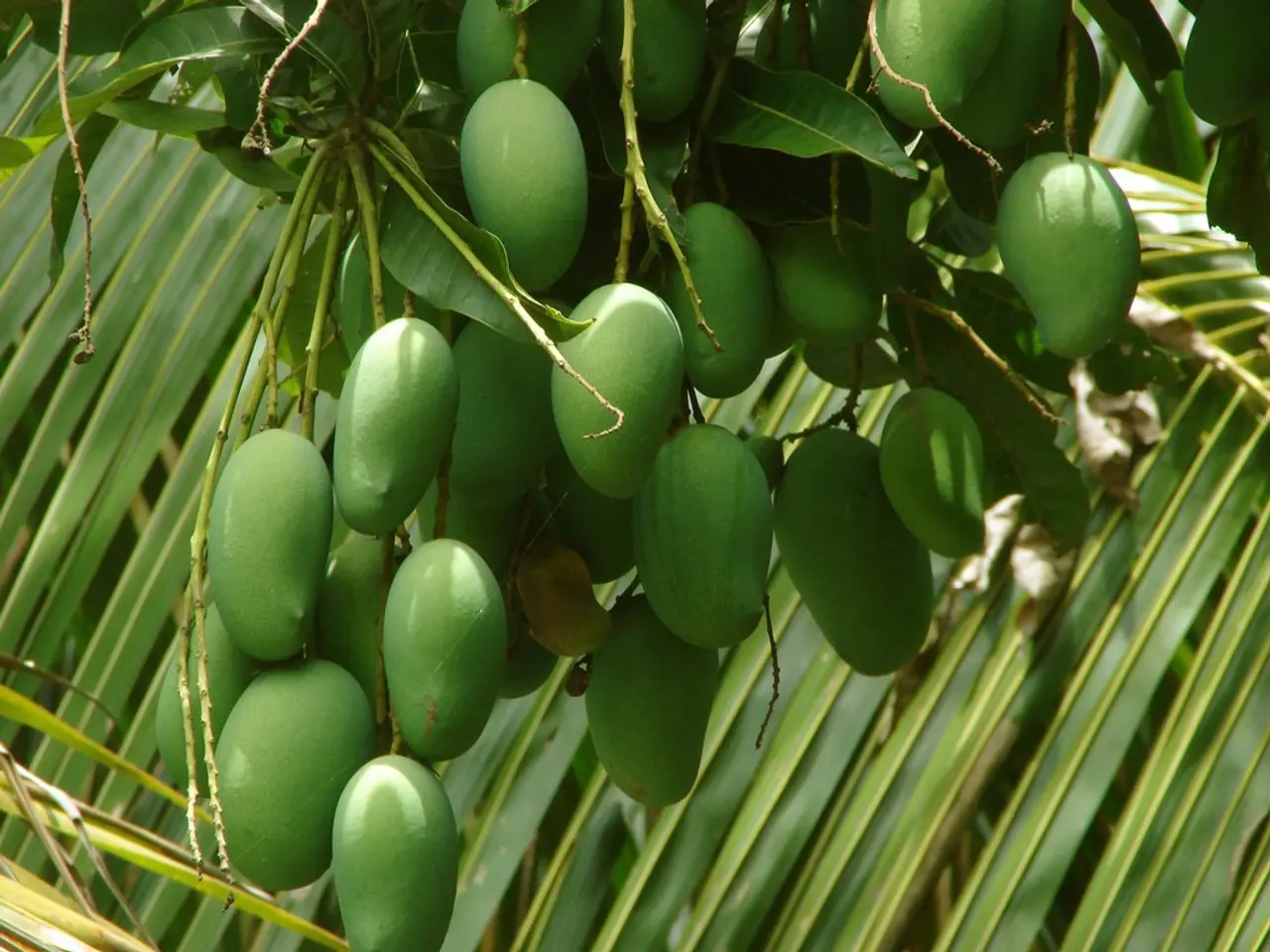
Projected Mango Yield for 2024-25 Stands at 228.37 LMT; Government Bolsters Aid for Farmers
In the bustling mango season of 2025, Indian mango farmers are finding solace in the government's Market Intervention Scheme (MIS), a crucial component of the Pradhan Mantri Annadata Sanrakshan Abhiyan (PM-AASHA). This initiative offers a lifeline to farmers, ensuring they receive fair prices for their produce during periods of price collapse or market glut.
Launched in 2024-25, the MIS provides compensation when market prices fall below a pre-determined "intervention price." For instance, Tamil Nadu requested Rs 62.93 crore to compensate farmers at Rs 2,766 per tonne, calculated from the input cost, average yield, and the market intervention price of Rs 7,776 per tonne[1]. The cost of compensation is shared equally between the central government and the respective state government, making it financially feasible and ensuring cooperative support in protecting farmers’ interests[1][2].
Under the Price Deficiency Payment Scheme (PDPS), when direct procurement of mangoes is not possible, farmers receive direct compensation to mitigate losses from prices falling below the Minimum Support Price (MSP). For example, Karnataka provided Rs 4 per kg in direct compensation to farmers[2][3].
The MIS also facilitates government procurement to absorb excess produce, stabilising prices. Karnataka approved the purchase of 2.5 lakh metric tonnes of mangoes at Rs 1616 per quintal to help farmers amid low prices caused by weather disruptions and market irregularities[3].
The new component under MIS, the Price Differential Payment (PDP), was introduced from the 2024-25 season. This allows direct payment to farmers for the gap between the Market Intervention Price (MIP) and the actual sale price[4].
The higher production in 2024-25 is primarily due to better output of processable mango varieties, particularly in the southern states. Financial assistance is available from APEDA, Agriculture Infrastructure Fund (AIF), and MIDH for setting up accredited packhouses and other infrastructure to boost mango exports[5].
The institutional foundation for mango research and development in India is strong, with the Indian Council of Agricultural Research (ICAR) actively involved through institutions like the Central Institute of Subtropical Horticulture, the Indian Institute of Horticultural Research, and the Indian Agricultural Research Institute. ICAR runs 23 All India Coordinated Research Project (AICRP) centres for mango research[6]. State Agricultural Universities also contribute to research in mango cultivation, post-harvest management, and value addition[6].
Moreover, the Ministry of Agriculture and Farmers Welfare supports mango growers through the Mission for Integrated Development of Horticulture (MIDH), providing end-to-end support, including nursery development, production, post-harvest handling, and marketing infrastructure creation[7]. These institutes have developed nearly a dozen commercial mango varieties[8].
The UAE continues to be the top destination for Indian mango exports[9]. With these initiatives in place, India's mango sector is poised for sustainable growth, ensuring farmers can continue to reap the benefits of their hard work while meeting the nation's demand for this beloved fruit.
[1] https://www.thehindubusinessline.com/economy/agri-business/tn-mango-farmers-to-get-rs-2766-per-tonne-as-compensation/article31517761.ece [2] https://www.thehindubusinessline.com/news/national/karnataka-to-compensate-mango-farmers-for-losses/article31526891.ece [3] https://www.thehindubusinessline.com/news/national/karnataka-to-buy-2-5-lakh-tonnes-of-mangoes-at-rs-1616-per-quintal/article31522851.ece [4] https://www.thehindubusinessline.com/economy/agri-business/government-to-compensate-mango-farmers-for-price-deficiency/article31522848.ece [5] https://www.thehindubusinessline.com/news/national/mango-production-to-reach-228-37-lakh-tonnes-in-2024-25/article31517693.ece [6] https://www.icar.org.in/ [7] https://midh.gov.in/ [8] https://www.icar.org.in/icar-developed-commercial-mango-varieties/ [9] https://www.trademap.gov.in/CountryProfileCountryDetails.aspx?CV_CD=167
In light of the Market Intervention Scheme (MIS), farmers can expect financial assistance for their mango produce, compensating them when market prices fall below a pre-determined level. This support extends to the food-and-drink sector, providing a positive impact on the overall lifestyle of farmers. As the MIS also facilitates business opportunities, it solidifies the government's commitment to enhancing the financial stance of farmers while ensuring the nation's demand for the beloved fruit is met.




