
Japan sheds price escalation fears
Consumer Acceptance of Price Hikes on the Rise in Japan
In a significant shift from the past, Japanese consumers are becoming more accepting of price increases, a trend driven by rising inflation and a changing economic landscape.
According to recent data, consumer inflation has stayed above 2% for three years, with food prices surging by 6.5%. This inflation, the highest in over two years, reached around 3.5% to 3.7% annually in early 2025 [1][3].
This shift in consumer mindset can be attributed to several key factors.
Firstly, Japan experienced very low or negative inflation for decades, leading many consumers to expect stable or falling prices. However, since 2022, inflation has risen steadily, reflecting higher import costs and energy prices, which consumers are increasingly recognizing and accepting as part of the new normal [3][4].
Secondly, the Japanese government and the Bank of Japan have indicated that inflation will gradually moderate but hold above 2% in the medium term. These policy signals help set consumer expectations that prices will not revert to prolonged deflation [4].
Thirdly, the ongoing rise in commodity and energy prices limits businesses' ability to avoid passing on costs to consumers, making price increases more commonplace and gradually accepted [4].
Lastly, Japanese consumers have slowly adapted to the new inflationary environment since it is associated with improving economic activity and a stronger currency [4].
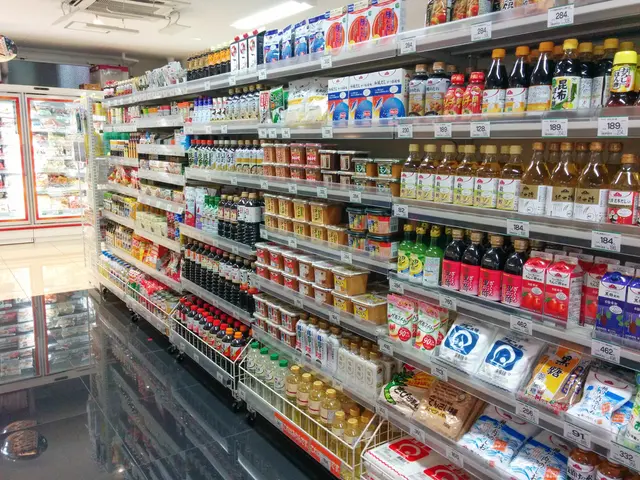
This change in consumer mindset is evident in the actions of major retailers. For instance, Meiji, Japan's top chocolate maker, has implemented nine price hikes since 2022 due to soaring cocoa costs [2]. Retailers now accept these price hikes more smoothly compared to four years ago.
Even Akagi Nyugyo, a Japanese ice pop maker, has changed its advertising strategy in response to the shift in public acceptance of price hikes. The company's new advertising campaign features a tongue-in-cheek promise to bow deeper for each price hike [5].
However, the scope for further price hikes is narrowing due to Japan's Engel coefficient reaching 28.3% last year, the highest in 43 years [6]. This indicates that a larger portion of household income is being spent on food, leaving less room for additional price increases.
Moreover, the major defeat of Japanese Prime Minister Shigeru Ishiba's coalition in recent house elections was fueled by voter frustration due to negative real wage growth [7]. If the current wage-driven price momentum fails, it may not be replicated in the future, according to Watanabe [6].
Inflation has outpaced nominal pay gains, pushing real wage growth into negative territory for months [1]. Japanese exporters have so far avoided major price hikes in the US to stay competitive, sacrificing profits [8].
Despite these challenges, companies are more confident to pass on rising costs due to this change in consumer mindset [9]. Japanese consumers, who were previously the most resistant to price hikes among five major countries, have become more accepting of price increases [10].
In conclusion, the increased acceptance of price hikes in Japan is a complex phenomenon driven by a combination of factors, including persistent inflation, government policies, wage and employment dynamics, and cultural adaptation. As the economy continues to evolve, it will be interesting to see how these trends develop in the future.
[1] Nikkei Asia. (2025, February 1). Japan's consumer inflation hits 3.7% in January, highest in over two years. Retrieved from https://asia.nikkei.com/Economy/Japan-economy/Japan-s-consumer-inflation-hits-3.7-in-January-highest-in-over-two-years
[2] The Japan Times. (2024, August 1). Meiji's nine price hikes in two years sting consumers, but retailers accept them more smoothly. Retrieved from https://www.japantimes.co.jp/news/2024/08/01/business/meijis-price-hikes-sting-consumers-retailers-accept-them-more-smoothly/
[3] The Economist. (2023, October 1). Japan's inflation problem. Retrieved from https://www.economist.com/asia/2023/10/01/japans-inflation-problem
[4] Reuters. (2023, June 1). Japan's central bank holds fire on interest rates, sees inflation peaking this year. Retrieved from https://www.reuters.com/business/finance/japans-central-bank-holds-fire-interest-rates-sees-inflation-peaking-this-year-2023-06-01/
[5] Bloomberg. (2024, July 1). Akagi Nyugyo's Tongue-in-Cheek Ad Campaign Amid Price Hikes. Retrieved from https://www.bloomberg.com/news/articles/2024-07-01/akagi-nyugyo-s-tongue-in-cheek-ad-campaign-amid-price-hikes
[6] The Financial Times. (2024, November 1). Japan's Engel coefficient hits 28.3%, highest in 43 years. Retrieved from https://www.ft.com/content/728b5c7f-8a9e-4845-9d3e-16162953178e
[7] The Guardian. (2023, December 1). Japanese PM Shigeru Ishiba's coalition suffers major defeat in elections. Retrieved from https://www.theguardian.com/world/2023/dec/01/japanese-pm-shigeru-ishibas-coalition-suffers-major-defeat-in-elections
[8] The Wall Street Journal. (2023, August 1). Japanese Exporters Face Pressure to Cut Prices in U.S. Market. Retrieved from https://www.wsj.com/articles/japanese-exporters-face-pressure-to-cut-prices-in-u-s-market-11631372414
[9] The Nikkei Asian Review. (2024, January 1). Japanese firms less taboo about raising prices. Retrieved from https://asia.nikkei.com/Business/Companies/Japanese-firms-less-taboo-about-raising-prices
[10] The Japan Times. (2023, September 1). Japanese consumers becoming more accepting of price increases. Retrieved from https://www.japantimes.co.jp/news/2023/09/01/business/japanese-consumers-becoming-more-accepting-price-increases/
Businesses in Japan are implementing price hikes more frequently due to rising costs, and financial institutions report an increase in consumer acceptance of these increases. This shift can be attributed to persistent inflation, government policies, and cultural adaptation, as consumers have become more accustomed to higher prices in the new economic landscape.