
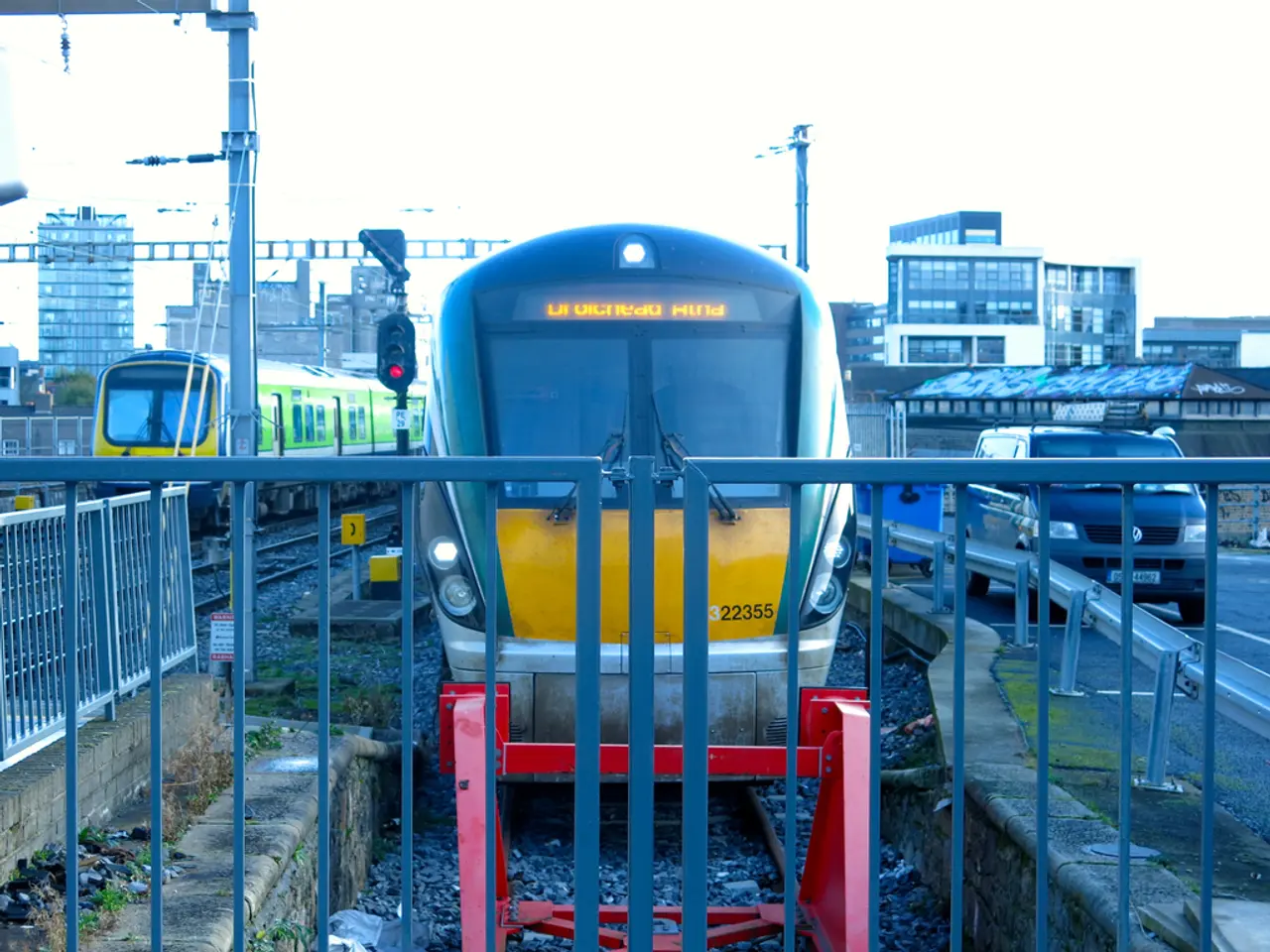
Railway authorities in Germany will shoulder extra expenses related to the Stuttgart 21 project. - German Railways (Deutsche Bahn) continues to bear extra expenses related to the Stuttgart 21 project
In the heart of Stuttgart, Germany, the construction of the ambitious Stuttgart 21 rail infrastructure project began in 2010. However, the project has faced several delays and escalating costs, leading to a legal dispute between Deutsche Bahn and the project partners.
At the core of this dispute is a "talking clause" in the financing agreement from 2009. This clause, a provision that allows parties to discuss or renegotiate aspects related to cost overruns and other financial disputes, has proved instrumental in managing financial disagreements.
The "talking clause" provides a mechanism for dialogue rather than immediate legal or financial penalties when unexpected costs arise. In the context of Stuttgart 21, this flexibility has meant that when the project's costs exceeded initial estimates by hundreds of millions of euros, Deutsche Bahn and project partners have been able to negotiate the distribution of these overruns, avoiding immediate legal conflict or unilateral burden.
The clause has been a subject of political controversy and public opposition due to escalating expenses and challenges in financing the project. While public political promises, such as the commitment by then-Stuttgart mayor Wolfgang Schuster to hold a local vote if costs rose by more than €200 million, were contentious, the talking clause internally has helped manage financial disputes by allowing negotiation and compromise instead of immediate contractual penalties or claims.
Despite the ongoing legal dispute, the Stuttgart 21 project is progressing. The new underground main station, which will serve as a through station, is a significant part of the project. The railway has announced that it will only partially commission Stuttgart 21 by the end of 2026. Some regional traffic will continue to end at the old terminal station until July 2027, while long-distance and some regional traffic will start using the new underground station from December 2026.
The Stuttgart 21 project also includes the new construction of the high-speed line Wendlingen-Ulm, which was opened in 2022. The project involves the construction of numerous railway stations, tracks, tunnels, passages, and bridges.
It is important to note that while the project partners had agreed to enter into discussions in the event of cost overruns, no obligation to negotiate or claim for contract adjustment can be derived from this. The phased commissioning is due to the need to stagger closures required for connecting the new infrastructure to existing lines.
In summary, the "talking clause" in the Stuttgart 21 financing agreement has facilitated cooperative cost allocation between Deutsche Bahn and project partners during budget increases, helping prevent immediate legal disputes and allowing dialogue instead. The project's progress continues amid ongoing political and public controversy.
[1] This explanation is based on the general understanding of such clauses as dialogue mechanisms in complex infrastructure financing agreements to manage cost risk jointly rather than litigate immediately. Limited specific detail is available about the exact legal wording and case examples of the talking clause in the Stuttgart 21 project.
- Despite the political and public controversy surrounding the Stuttgart 21 project, the "talking clause" in its financing agreement, designed as a dialog-promoting mechanism for managing cost risks, has prevented immediate legal disputes by enabling negotiations and compromise between Deutsche Bahn and project partners regarding cost overruns.
- The success of the Stuttgart 21 project in progressing while adhering to the "talking clause" is not only relevant to the railway industry but also to other sectors such as finance and business, as such clauses can provide a useful tool for managing complex financial disputes effectively, offering a pathway towards cooperation rather than litigation.


%20continues%20to%20bear%20extra%20expenses%20related%20to%20the%20Stuttgart%2021%20project)